On this page (6)
You will also come across the abbreviation APNR and the American term LPR (license plate recognition). All three mean the same thing.
How number plate recognition works
Every read goes through the same stages:
- detecting a vehicle in the camera’s field of view,
- finding the plate in the image,
- reading the characters and turning the image into text,
- checking against the database: does this number have a permission, is it booked, is it expected.
The whole cycle takes a fraction of a second and repeats many times as the vehicle approaches, so the system collects a series of reads and only then picks the result.
From that series, the read with the highest weight wins, not the last one. The last frame is often the worst, because the vehicle is already too close or standing at an angle. Choosing the “last seen” read instead of the “best” one is a typical design flaw: the system appears to work, and every so often it gets a plate wrong in a way nobody can explain.
What read accuracy depends on
Most of it depends on how the camera is set up. Angle, height and distance matter more than resolution, and a camera looking at the plate at a steep angle will make mistakes however much it cost. Second comes lighting: infrared illumination takes care of the night, and the real trouble is more often the sun shining straight into the lens at a certain time of year.
A dirty, bent or partly covered plate won’t be read correctly, and no supplier can change that. Vehicle speed is rarely a problem, because it is low when a vehicle drives up to a barrier.
Read accuracy is a property of the installation, not of the product. The same recognition engine will give different results at two gates of the same plant if they differ in camera angle and lighting. A reliable figure comes from measuring in the actual conditions, and a percentage quoted in an offer without a description of how it was measured tells you nothing.
ANPR and opening the barrier
Recognising the plate comes before the decision to open the barrier, but it doesn’t settle it. Between the two sits the permission logic: whether the vehicle is on the list, whether it has a valid booking, whether it is under a ban and whether it has arrived at the right time.
That distinction matters when you compare offers. A “camera that recognises plates” is a component, and a vehicle entry control system is that component together with access rules and event logging.
What ANPR does not do
ANPR doesn’t recognise the driver. It reads the vehicle’s number and says nothing about who is behind the wheel. Nor will it read an illegible plate: dirt, damage, film or anything covering the plate puts it beyond the reach of the method.
An ANPR camera is not a measuring instrument. Calculating speed over the section between two cameras is possible, but it is not a measurement within the meaning of Polish metrology law and cannot be the basis for a fine. ANPR doesn’t replace CCTV either, because the camera is there to recognise the number, and continuous recording is the job of the video surveillance system.
Number plate recognition in TraxSystem
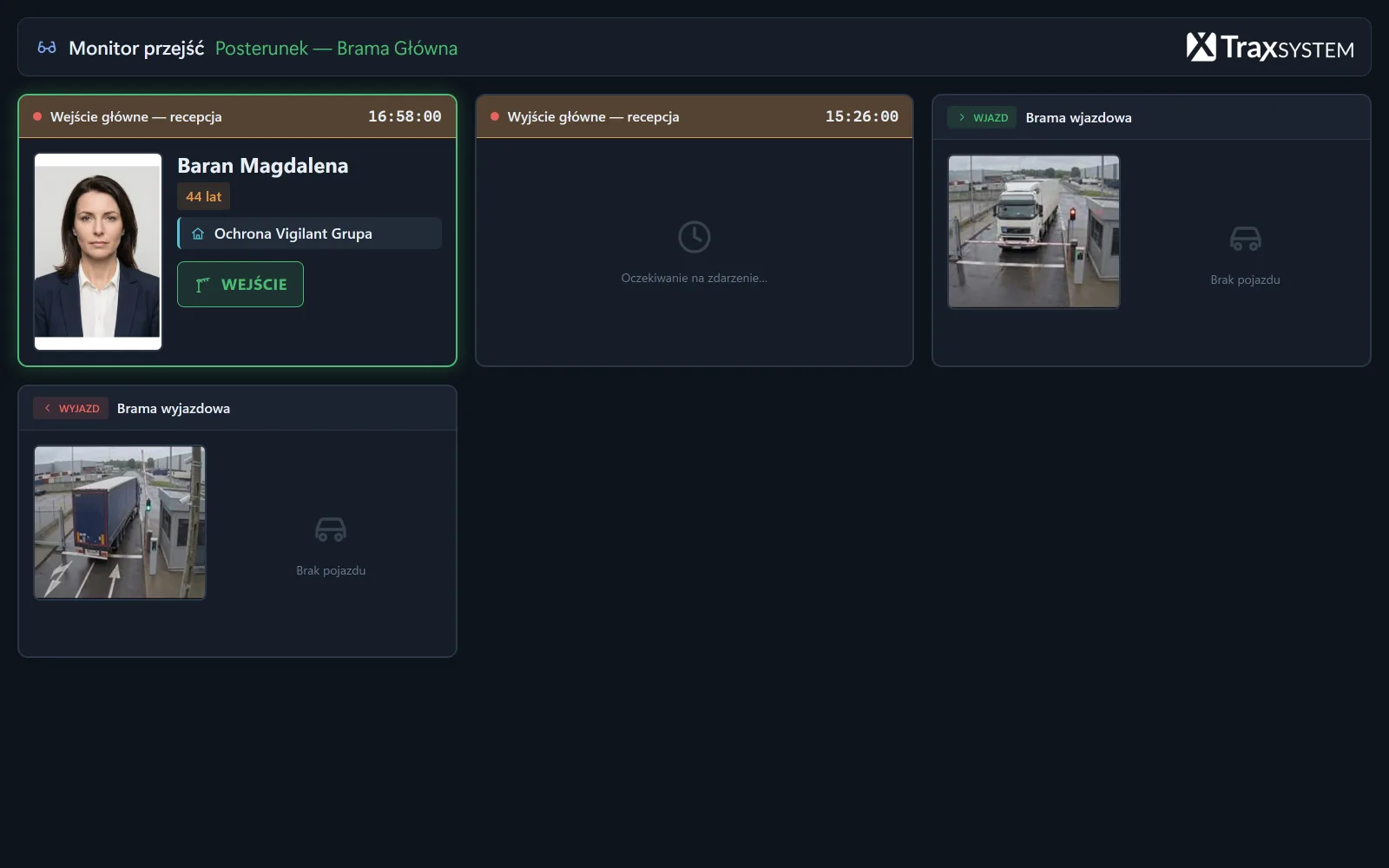
TraxSystem recognises plates in images from IP cameras that send an RTSP stream. The image is processed live and is not recorded continuously, and the system saves photos of the vehicle at entry and exit with the visit. TraxSystem does no facial recognition. Where the link to the gate is weak, the edge variant does the job: a device at the gate recognises the plate itself and sends the server a finished read instead of a video stream.
Number plate recognition is part of the system’s base package, so you don’t buy it as a separate module. The price of the base package is set by the size of the site, meaning the number of gates and the number of workstations in use at the same time, and the amounts for each base size are on the pricing page. Cameras and other hardware are priced separately from the licence. Whether the cameras already on site are suitable is assessed in the pre-implementation analysis, because not every CCTV camera is fit for ANPR.
Questions and answers
Can we use the cameras we already have?
Sometimes, yes. It depends on the camera model, where it is mounted and the lighting. It is one of the first questions in the pre-implementation analysis, so you know the answer before the contract is signed.
What happens when a plate isn’t recognised?
The operator sees the event and enters the number by hand or opens the gate on their own decision. An unrecognised plate doesn’t block traffic, and the system keeps working.
Does ANPR work at night?
Yes, with suitable illumination. Cameras designed for ANPR usually have their own infrared lighting.
See also: Edge vs cloud ANPR: what is the difference · Do you need new barriers and cameras to implement the system · Speed limits on site: can they be monitored