On this page (7)
What changes in the gate operator’s work
The gate operator goes out to each vehicle mainly to check the number and raise the barrier. When the number checks itself, the most frequent task of the shift disappears, and the operator is left with the vehicles that need a decision: no booking, a warning, an expired induction, or a load that calls for a word with the driver.
So the benefit of number plate recognition lies less in faster entry and more in the fact that vehicles that were entitled to come in anyway no longer need handling at all.

Automatic barrier opening only on one-way gates
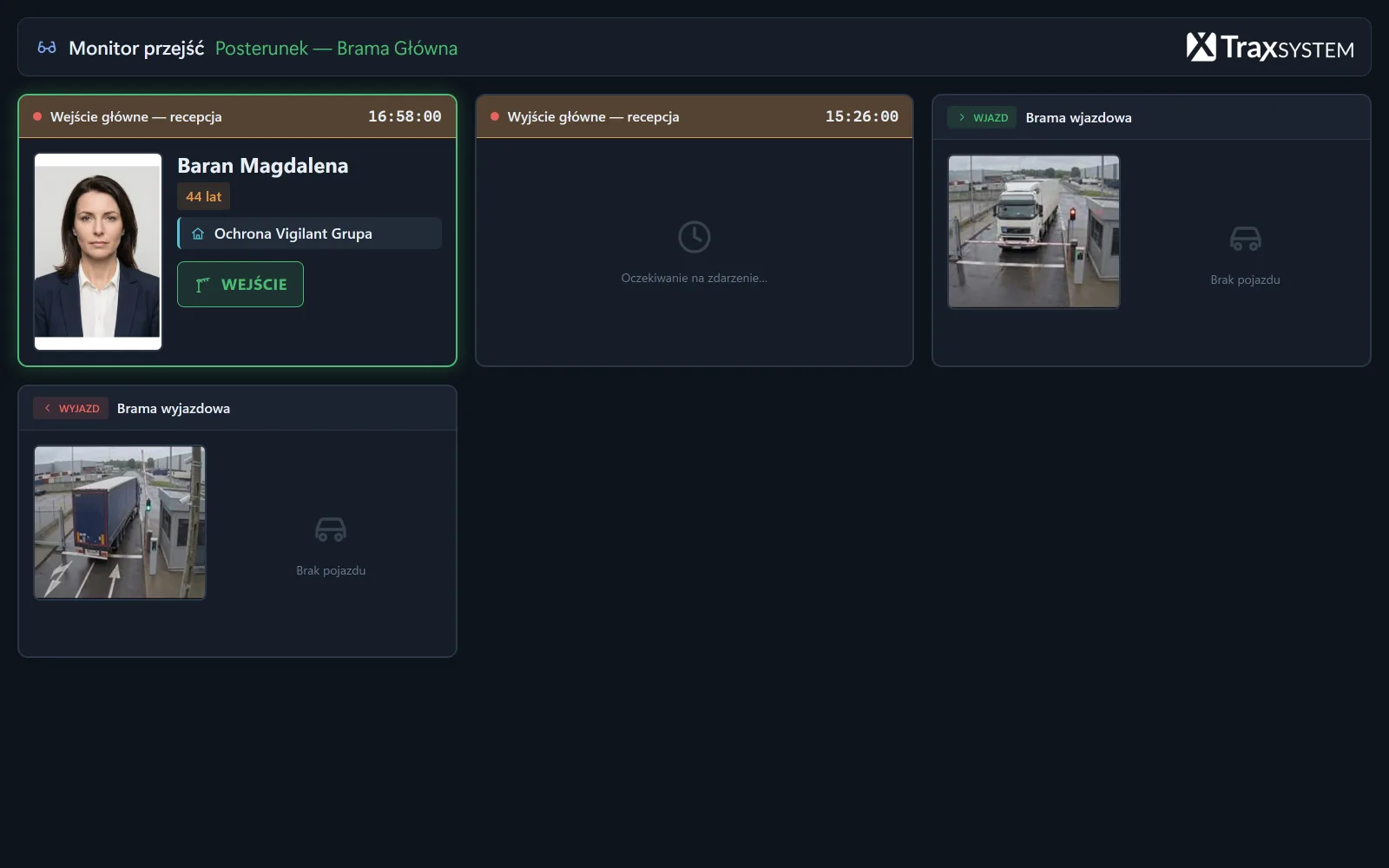
Automatic barrier opening in TraxSystem works only on one-way gates, that is, where a gate is used only for entry or only for exit, and the decision is based on an access rule.
Two-way gates, vehicles with an entry ban, vehicles without a booking, drivers with an expired induction and uncertain reads always go to the operator. An automatic system that settled these cases by itself would stop an ambulance and let in a vehicle whose number differs by one character, so the decision stays with a person.
Recognition on the server or on a device at the gate
Number plate recognition usually needs either a server with a powerful graphics card or images sent to an external service. TraxSystem offers a third option: an edge device at the gate, which recognises the number on the spot and sends only the result to the server.
With an edge device the server needs no graphics card, so hardware costs fall. The camera image does not go to any external service or over the internet, so in conversations about personal data the question of sending images never comes up.
The edge device updates itself through the server, so it does not need a service visit every time the version changes. There is more about it on the devices page.
Photos and clips of key moments
In TraxSystem the camera pipeline works as a stream, in memory: live view and plate recognition do not require images to be stored on disk. From that stream the system saves the key moments of a visit: photos of the vehicle on entry and exit, attached to the visit, and at access control points with a camera also a photo of the passage and, if clip recording is enabled on the camera, a short MP4 recording of 5 to 60 seconds, including up to 30 seconds before the event. Photos and clips have their own retention periods in data retention, 60 days each by default.
TraxSystem is not a video recorder and does not record continuously, so it does not replace CCTV. Continuous recording is provided by your CCTV system, and the two can happily run side by side on the same camera.
Object detection, which tells what type of vehicle is in the image, runs separately, also locally and without external services.
What number plate recognition will not do
The camera cannot read a plate it cannot see. Dirt, snow, damage, a sharp angle, dazzling sun and a plate hidden behind a tow bar happen on every site, and then the vehicle goes to the operator, just as it did before the deployment.
Number plate recognition will not replace the entry log. A plate read is an event from which an entry is created in the vehicle log, together with the purpose of the visit, the driver and the documents.
The system does not recognise faces, does not carry out biometric identification and does not record video continuously. Nor will it work on a vehicle without plates: forklifts, construction machinery and test vehicles need a different form of identification.
Questions about number plate recognition
Do we need to replace our cameras?
Usually not, as long as the camera provides a stream in a standard network format and is positioned so that the plate fits in the frame at a sufficient resolution. Angle and lighting make more difference here than the device model. List of supported hardware.
How accurate is the reading?
That depends on the camera position, the lighting and the condition of the plates, which is why we do not give a single figure for all deployments. In the demo you can see exactly what happens with an uncertain read.
Do camera images go to the cloud?
No. Recognition takes place on the site’s server or on the device at the gate. That also applies to a deployment where the application server is in our cloud: the images still do not go to an external recognition service.
Can the barrier also be opened with a card or a remote?
Yes, and most sites combine both. Number plate recognition handles the predictable traffic, and the rest stays with the operator.
Related
Vehicle entry controlRoom bookingDevices and edge ANPRSupported hardwareSection speed measurement
Further reading: What is ANPR? · Edge vs cloud ANPR · Do you need to replace barriers and cameras?